There are not many weapons
specified in either “The Great Liquor War” or “Homesteader: Finding Sharon”.
First I’ll take a look at those mentioned specifically and then move on to
those that would be probable.
Hank James and most of those he
dealt with carried the Colt Single Action Army also called the “New Army”, the
“Peacemaker”, the “Frontier Single Six” and a host of other names derived from
the depths of some super salesman’s imagination. It was designed for the US
Army which called for a 7 ½” barrel and chambered for .45 Government. This was
quickly followed by .44-40 which allowed the user to have one cartridge for
both his Colt and his Winchester Model 1873. During its first production cycle
of 68 years it was available in a total of 27 calibers and in almost any barrel
length imaginable including perhaps a half dozen with 12” barrels for Edward
Judson, Jr. who wrote dime novels under the name Ned Buntline. True West
Magazine contributors have done extensive research and found that a few of
these “Buntline Specials” actually did exist. Several more have been made for
TV and Hollywood productions.
In “The Making of Jake McTavish” I have included a
“Sheriff’s Special” or “Storekeeper’s Model” which did not have an ejector
housing (no room) and came with a 4” barrel although 2 ½” and 4 ½” were also
made. Also mentioned in the “Jake” story is the Colt .36 Navy and since this
was long after percussion weapons it would probably be the 1861 model.
Below are the Colt SAA (this is a second generation model meaning it was made for smokeless powder sometime popularity forced Colt to make them again.)
A Colt Navy .36, 1861
A Colt SAA Sheriff's Model.


The British
Columbia Provincial Police were not issued weapons until many years after the
time depicted in these two novels but most carried the Colt “New Army” although
some preferred the S&W .44 American or the Remington Model 1875 Single
Action Army. Some carried one of the many .38 calibers available at the time in
both single action and (after the BCP Police had already been around for 25
years) double action revolvers. Since they often bought them out of their own
money what was chosen could be almost anything.
Here is a S&W .44 American and underneath it a Remington 1875 Army


The North
West Mounted Police who also feature prominently in “GLW” where first issued
the Snider-Enfield .577 carbine and a .450 Adams
revolver. However by the time of this story they had changed to the Winchester
Model 1876 military carbine in .45-70 and the Colt Single Action Army.

This is the Snyder-Enfield action. Snyder was an American inventor who developed a way to make the muzzle loader a breach loader.

The Adams .455

Winchester 1876 .45-70
Near the
climax of The Great Liquor War Hank’s friend Harry Gilmore saves Hank with a
shot from his “.50 Springfield ”.
From 1794 until 1968 many rifle models manufactured at the Springfield ,
Massachusetts
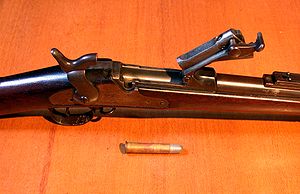
Springfield .50
Probably
the longest production run for a “Springfield” would be the M1 Garand (4.5
million copies) (.30-06 produced from 1936 to ‘57) and the last would, I think,
be the M14 in the NATO 7.62mm (.308 produced 1959 – ’64 and upgraded variations
still made).
At the end
of the GLW Hank collects a set of Remington 1875 Single Actions with a nickel
finish. In the early 1870s Remington lost out to Colt in the US Army contract
(a year late) but they did manage to attain contracts for other government
orders including one for the US Ministry of the Interior who issued nickel
plated Remington revolvers to many of the tribal police forces. These were
first issued in .44 Remington Centerfire and later in .44-40.

In later years Remington also released updated versions which I touch in on a story I'm working that, right now, I call "Cattle Business."

A rare 1888 version in .44-40

A Remington 1890
My last
release, “The Making Of Jake McTavish” takes place in 1898 and by this time the
bolt action rifle was becoming popular and available in new calibers. It was
also at this time that smokeless powder was introduced. Another weapon that I
introduce in this story is the Remington Double Deringer which was chambered
for .41 rimfire short.

During the
years depicted, the mid 1880s, there would have been a variety of weapons
available in both British Columbia and over the mountains in the North West
Territories and many where the same weapons found south of the 49th
parallel and most other places in the world. Most of those living in the area,
native, European, rural or urban fed themselves from the available wild life. Victoria
and New Westminster were actual
towns so many people there would rely on others to supply their meat but most
became familiar with most aspects of preparing their own food. Some weapons where
more popular than others, whether through availability, price or access to
ammunition but any rifle that one may have heard of could be found somewhere in
the west.
Avocation
could also have influence on what a person might want for a weapon. Trappers
for example would want something of a small caliber to dispatch their “catch”
both quickly and humanly without excessive damage to the pelt and therefore
often chose something like a .22. If they could afford it (or thought they
could) they might have a .22 revolver for trapping and a rifle in a much larger
caliber for bringing down meat. I’ve heard and read stories where a trapper decided
to back away from one of his traps and let “Mr. Bear” clean it out since all he
had on his hip was a .22 pistol.
As pictured
in “Homesteader” many of those working the wild cattle and horses of the time
would want a pistol with a fairly large bore. An 800 lb cow or steer can charge
a man very quickly and it takes something with serious impact to slow him or
her down. If you are being dragged through the brush by one foot hung up in a
stirrup you don’t want that to go on very long. (I can personally attest to
that!) Grizzly bears, timber wolves and coyotes can also view a 50 lb. calf as
a very tasty morsel and although these species have been taken with small
calibers it is probably best not to count on it.


