Showing posts with label North West Territories. Show all posts

Monday, November 20, 2017

An Excerpt from “The Making of Jake McTavish”

It has been far too long since I posted here, but with a few hours “release” from hauling fuel … well, take every opportunity to do what you really want.

Here are the first few words from my latest release. It has been quite some time since it was released but it still makes a gift for the reader, those who like a little history and geography hidden within their entertainment. With these first chapters it can give one an idea of what they might be getting either in print versions or in one of the digital formats that can be rushed to someone on-line.
And here is a link to the introduction I posted when Jake was first introduced.

Paying the Price for Rape and Murder


1


Omineca Country, British Columbia, 1898

Jake McTavish came out of the winter twenty pounds lighter and a whole lot meaner. Perhaps not meaner than he had been the fall before but definitely more than he had been before his wife had been murdered. That had been slightly more than four years in the past but he had not forgotten anything about it. The more he brooded here in the wilderness the more he detested the company of his fellow man.
That meant it was his fourth year taking furs from the Finlay River country, and the fourth year he wasn’t going to have any cash money once he re-supplied for the coming season. He had collected fur, but not much more than it would take to pay for supplies and repair equipment.
He was leaning against the door frame of his cabin, morning coffee in hand, gazing down toward the river, when he said, “Maybe I’ll just have t’ shoot somebody. That way the government will have t’ feed us ‘til they punch my ticket and bury me.”
Jake wasn’t paying much attention to what he was saying. The words were just noise to fill the empty cabin; and his only companion, the blue tick hound on the floor by the stove, always agreed with him.
After four years of talking to few but the hound Jake was beginning to think the animal understood. Having experienced the intelligence of the animal he had also begun believing he knew what the dog was thinking.
“Yeah, I know, problem with that is we’d have t’ find somebody to shoot,” Jake continued, and then added, “Chester, we gotta take them furs t’ the fort. Maybe there’ll be somebody there that’s worth a five-cent bullet.”
If Jake had been serious about shooting someone, perhaps he would have paid more attention to his surroundings. Had he done so, he might have saved himself from an attack on his life. However he did notice the hound briefly lift one eyelid and quickly let it close. Another person viewing his always serious expression probably wouldn’t have believed it but Jake found Chester’s reaction humorous. They had been out before dawn checking the few trap sets still near the cabin. The mornings were still cold and Jake was sure Chester was enjoying the heat of the fire. He also thought that over the course of the past few years Chester had heard enough of his master’s growling that he was extremely comfortable ignoring it.
Jake spent the rest of the day closing up camp. He had already tripped any open traps that morning and only had four fresh hides - three beaver and a martin - to set out on drying frames. The few supplies that had managed to make it through the winter he put up in his cache cabin - a solid tree house built high between two pine trees. He gave his canoe a very careful check for damage and placed it in the water, tied securely to the log dock.
He decided to take the fresh hides laced in their drying frames by setting them on the three small bales of furs he would load in the canoe. It was precarious, considering some of the white water he would have to shoot, but he could tie them in place. The alternative was to leave them to be included in next years take, but he thought he needed everything he could get this year. Besides, if he left them he would probably find them ripped up by coyotes or wolves when he returned. Leaving them in the cabin or cache would fill those structures with enough stink to attract a grizzly. Given enough incentive a silver tip would break into anything.
The first part of the trip went as Jake had planned; and since it was his fourth trip down to Ft. St. John this was not a particular surprise. It had been a short, mild winter and he was late enough in the season that he saw very little ice, except for a few small pieces melting away from their perches on driftwood where they had been forced by the earlier heavy run off. The water was still high enough that he could avoid portaging, but low enough that he managed to keep the canoe upright with his cargo inside the craft.
Some stretches of river did create heart pounding moments. Jake was not one to admit it, even to himself, but adrenaline flowed and he worked hard to avoid rocks and whirlpools. Chester, in his assigned space at the front of the canoe, put his chin on the ribbing and his paws over his nose.
There was just enough light for Jake to shoot the last rapids on the Finlay, and enough dark that he could steer wide around the settlement of Finlay Forks without attracting attention. Everyone stopped at the landing. After a winter in the bush most men wanted company and conversation. Jake wanted neither. He also didn’t want to put up with fur traders trying to deal him out of his pelts for less than top price.

***

Two men did see him from the dock as he turned into the Peace River. One was known as Sam Twice. He had been born into the Beaver Nation but was accepted at no lodge, including that of his own family. The other was Martin Prentice, a man who definitely was wanted. He was wanted by the law in both the State of New York and the Province of Ontario. The town police in Winnipeg and Calgary would have also liked to talk to him, but they were not aware he was the one who had committed the crimes.
In the twilight Sam Twice made a flicking motion with one finger toward the silhouette out on the water. “Him maybe got fur,” he said.
“I expect he does,” Martin agreed. He took a swig from the jug he held and passed it to Sam. “Perhaps he also has a small poke of gold he’s panned out of streams.”
“Why him not come in?” Sam asked. He flicked a finger toward the large cabin that served as store, saloon, and hotel as long as one wasn’t too particular about prices, liquor quality, or sleeping on the floor. He took a swig from the jug which the two had purchased at the store. Sam didn’t care about the quality of the refreshment since he had never had anything better.
“I expect he wants more than half price for his pelts,” Martin replied. “He’ll take them down to Ft. St. John where he’ll get as much as he can get in this country.”
“Don’ like that man boss that Fort John place,” Sam said. “He marry Beaver girl. She nice girl, one time.”
Martin looked at Sam a moment. He knew there was much about Sam’s past that he didn’t know, but he didn’t really care. Sam was useful from time to time, and that was all the mattered. “I heard his wife was Cree, but what do I know? I’ve never even seen the woman.”
Sam grunted, giving Martin no idea what he meant.
Martin waved toward the silhouette of man and canoe fading into the gathering darkness. “Now, that pilgrim will undoubtedly stop for the night. Tomorrow he’ll go on to Portage Mountain. If we were to float down the river right now we could be at Portage to meet him.”
“I like maybe stay here an’ drink,” Sam objected. He wasn’t one to hasten toward any effort that wasn’t absolutely necessary.
“How would you like to have a nice canoe?” Martin asked.
Sam looked at Martin with hard, cold eyes. “I get canoe an’ you get fur?”
“No, no,” Martin objected. “We split the furs and you get the canoe. After all, I already have a canoe.”
Sam nodded several times, then placed the cork in the jug and hit it with the heel of his hand. “We go.”


2


Peace River, Portage Mountain, British Columbia, 1898

There was no question about pulling out of the water upriver from Portage Mountain. Even in late August, when the water flow may have dropped several feet, no one in their right mind would try to shoot the Peace Canyon.
It was mid afternoon of their second day of travel when Jake pulled in to the river bank. Chester jumped out onto dry ground and ran to the nearest aspen where he lifted his leg.
Pulling the canoe up so the current couldn’t take it, Jake said, “Mighty fine idea, Chester. You’re a smart dog.”
Jake unloaded his canoe and dragged the craft up onto dry ground. Chester sat on his haunches, looked at the bales of furs and supplies, swung his gaze up the trail, and then looked back at the cargo.
“We ain’t in a hurry, Chester. We’ll spend the night here. Go see if yuh can find a rabbit.”
Chester headed off into the bush and Jake collected firewood.
At the start and end of any portage there are well-used camp areas; and if the trail to more water is long enough, more stopping places along the way. The Portage Mountain trail - a long walk without carrying a pack - was no exception. There were several sites that had been used on the upriver end. Jake chose one of the spots as far back as possible from the trail end and riverbank and started his fire. If there were other travellers, he wanted to avoid company if possible. He didn’t mind carrying a little water.
While the fire burned down to coals he moved his freight and canoe up to the camp site. Gathering firewood, he noticed a small aspen sapling and cut it with his knife. Back at the fire he skewered a piece of moose meat with the green stick and drove the butt end of the stick into the ground so the meat was suspended over the coals.
As the meat was heating up to a sizzle he mixed up some bannock batter, wound it around another piece of green stick and propped that over the fire.
Chester sauntered into camp and dropped to the ground at the edge of firelight.
“You’re getting lazy, old man,” Jake said. “First smell o’ cookin’ meat an’ you come back.”
He turned his gaze to the hound and saw the relaxed, satisfied look and the long tongue licking lips.
“I apologise, old man. I don’t know what you mighta found t’ eat on this pile o’ rocks, but you’ve found somethin’.”
When he finished eating and washing up, Jake threw a couple of sticks on the fire and propped the canoe up so it would collect and hold the heat for his bed. He propped himself up against a dry log, loaded his pipe and leaned back puffing contentedly.
“Nothin’ wrong with this, Ches. Nice warm night.”
Surprised at his master’s good mood, Chester grunted.
During breakfast the next morning Jake decided to continue taking it easy. Even though the two bundles of furs were not very large he would pack them around the mountain one at a time. The four fresh plews had not been properly treated, but they were dry so he decided to tie them on to one of the bundles. He pulled a bag full of string and sinew from his possibles pack and wrapped the hides in place, cutting the ends of sinew off and putting them back in the bag.
He was already on the trail when he realized he hadn’t put his knife back in the sheath. He hesitated, decided he would pick it up on the next trip, and started off again.
He had only taken a few steps when he heard Chester off the trail to his right. There was the beginning of a bark followed by a howl that was abruptly cut off. Jake swung the pack of furs from his shoulders, dropped it to the trail, and stepped into the brush.
There was blinding pain from the back of his skull. He saw a light as bright as the sun. Then he fell into blackness.


Monday, December 7, 2015

A few more weapons from Canada's past

In an earlier post I mention the Adams revolver that the North West Mounted Police were originally issued and that they eventually wound up with the Colt SA Army but over the years they have been subject to a variety of “issue” weapons.

My “Cattle Business” story which might see release in 2016 and tells a story from 1896 (yes, as usual there are some historical aspects) mentions several weapons. Within that story is mention of the British military and the Enfield revolver they issued (and used by some NWMP officers). The Adams and Enfield were replaced by the Colt SA Army and within a few years by the Colt Double Action Army. The first issue of the DA Army was in .44-40 to offer continuance of cartridge but then the .38 Smith & Wesson Special or .38 Special became popular and later Colt DAAs were in that cartridge. Eventually the Smith & Wesson Model 10 became the standard for many police forces.
Enfield Mk II .476
Replaced by the Colt Frontier Double Action (Model 1895)
Replaced by the S&W Model 10


In 1885 the Remington – Lee was being sold in .45 – 70 Government in North America and in at least two other calibers world wide. It has been called the first “modern military” rifle and was supplanted by another weapon with the James Lee magazine, the Lee Enfield, primarily in .303 British.

The armorers who train and advise the RC Mounted Police come from a variety of backgrounds. Their training and what they attempt to pass on to police officers is unsurpassed. However they are subject to pressure from politicians looking for votes and caring little for practical requirements and find themselves issuing weapons that at best are only marginal for the task.
Such is the case with a weapon chambered for either a .38 S&W Special or 9mm; a perfectly adequate cartridge for a trained officer in an urban setting but outclassed by several other cartridges in a rural setting.
I mentioned Elmer Keith in an earlier post and his attachment to both the .357 Magnum and the .44 Magnum. Keith was a prospector, cowboy, guide and hunter who over-loaded .38 Special brass back in the late 1920s which resulted in the development of the .357 cartridge and the discovery that it was by far the caliber best suited for most rural police forces. Later Keith overloaded .44 Special cartridges in his Colt SA Army for the hunting of Elk and deer.
That is to say, several Colt SAAs since his hot loads tended to break the top strap at the front of the cylinder and destroy the weapon even though he was successful most years with his hand-gun hunting.
Keith went to several companies attempting to have them design a .44 brass slightly longer than the .44 Special and eventually Remington agreed to do so. Then he went to S&W and convinced them to make the S&W Model 29 in .44 Magnum which they did. However, Bill Ruger heard about the impending release of the new pistol cartridge intended for hunting and released the Ruger Super Blackhawk before the S&W Model 29 made it to sales.
A stainless steel Ruger Blackhawk .357 M
A nickled (except for the cylinder) Ruger Super Blackhawk in .44M
Note the heavy top straps.


Wednesday, November 25, 2015

The tools presented in GLW and Homesteader

There are not many weapons specified in either “The Great Liquor War” or “Homesteader: Finding Sharon”. First I’ll take a look at those mentioned specifically and then move on to those that would be probable.
Hank James and most of those he dealt with carried the Colt Single Action Army also called the “New Army”, the “Peacemaker”, the “Frontier Single Six” and a host of other names derived from the depths of some super salesman’s imagination. It was designed for the US Army which called for a 7 ½” barrel and chambered for .45 Government. This was quickly followed by .44-40 which allowed the user to have one cartridge for both his Colt and his Winchester Model 1873. During its first production cycle of 68 years it was available in a total of 27 calibers and in almost any barrel length imaginable including perhaps a half dozen with 12” barrels for Edward Judson, Jr. who wrote dime novels under the name Ned Buntline. True West Magazine contributors have done extensive research and found that a few of these “Buntline Specials” actually did exist. Several more have been made for TV and Hollywood productions.
In “The Making of Jake McTavish” I have included a “Sheriff’s Special” or “Storekeeper’s Model” which did not have an ejector housing (no room) and came with a 4” barrel although 2 ½” and 4 ½” were also made. Also mentioned in the “Jake” story is the Colt .36 Navy and since this was long after percussion weapons it would probably be the 1861 model.
Below are the Colt SAA (this is a second generation model meaning it was made for smokeless  powder sometime popularity forced Colt to make them again.)
A Colt Navy .36, 1861
A Colt SAA Sheriff's Model.


            The British Columbia Provincial Police were not issued weapons until many years after the time depicted in these two novels but most carried the Colt “New Army” although some preferred the S&W .44 American or the Remington Model 1875 Single Action Army. Some carried one of the many .38 calibers available at the time in both single action and (after the BCP Police had already been around for 25 years) double action revolvers. Since they often bought them out of their own money what was chosen could be almost anything.
Here is a S&W .44 American and underneath it a Remington 1875 Army


            The North West Mounted Police who also feature prominently in “GLW” where first issued the Snider-Enfield .577 carbine and a .450 Adams revolver. However by the time of this story they had changed to the Winchester Model 1876 military carbine in .45-70 and the Colt Single Action Army.
This is the Snyder-Enfield action. Snyder was an American inventor who developed a way to make the muzzle loader a breach loader.

The Adams .455

Winchester 1876 .45-70


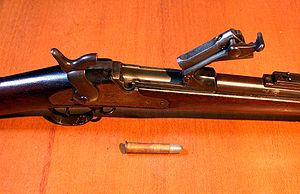
            Near the climax of The Great Liquor War Hank’s friend Harry Gilmore saves Hank with a shot from his “.50 Springfield”. From 1794 until 1968 many rifle models manufactured at the Springfield, Massachusetts Armory were referred to as “Springfields” but with the caliber specified it probably would be a .50 trap-door single shot US Army rifle Model 1873 made in the Springfield Armory starting in 1873. Designed for the US Army (with carbines for the Cavalry) many made their way into civilian hands.
Springfield .50

            Probably the longest production run for a “Springfield” would be the M1 Garand (4.5 million copies) (.30-06 produced from 1936 to ‘57) and the last would, I think, be the M14 in the NATO 7.62mm (.308 produced 1959 – ’64 and upgraded variations still made).

            At the end of the GLW Hank collects a set of Remington 1875 Single Actions with a nickel finish. In the early 1870s Remington lost out to Colt in the US Army contract (a year late) but they did manage to attain contracts for other government orders including one for the US Ministry of the Interior who issued nickel plated Remington revolvers to many of the tribal police forces. These were first issued in .44 Remington Centerfire and later in .44-40.
In later years Remington also released updated versions which I touch in on a story I'm working that, right now, I call "Cattle Business."
A rare 1888 version in .44-40

A Remington 1890


            My last release, “The Making Of Jake McTavish” takes place in 1898 and by this time the bolt action rifle was becoming popular and available in new calibers. It was also at this time that smokeless powder was introduced. Another weapon that I introduce in this story is the Remington Double Deringer which was chambered for .41 rimfire short.


            During the years depicted, the mid 1880s, there would have been a variety of weapons available in both British Columbia and over the mountains in the North West Territories and many where the same weapons found south of the 49th parallel and most other places in the world. Most of those living in the area, native, European, rural or urban fed themselves from the available wild life. Victoria and New Westminster were actual towns so many people there would rely on others to supply their meat but most became familiar with most aspects of preparing their own food. Some weapons where more popular than others, whether through availability, price or access to ammunition but any rifle that one may have heard of could be found somewhere in the west.
            Avocation could also have influence on what a person might want for a weapon. Trappers for example would want something of a small caliber to dispatch their “catch” both quickly and humanly without excessive damage to the pelt and therefore often chose something like a .22. If they could afford it (or thought they could) they might have a .22 revolver for trapping and a rifle in a much larger caliber for bringing down meat. I’ve heard and read stories where a trapper decided to back away from one of his traps and let “Mr. Bear” clean it out since all he had on his hip was a .22 pistol.

            As pictured in “Homesteader” many of those working the wild cattle and horses of the time would want a pistol with a fairly large bore. An 800 lb cow or steer can charge a man very quickly and it takes something with serious impact to slow him or her down. If you are being dragged through the brush by one foot hung up in a stirrup you don’t want that to go on very long. (I can personally attest to that!) Grizzly bears, timber wolves and coyotes can also view a 50 lb. calf as a very tasty morsel and although these species have been taken with small calibers it is probably best not to count on it. 

Sunday, August 3, 2014

North West Mounted Police livestock Part 2


Is it not about time I finish this story?

            Yes, the Mounted Police had left Dufferin on July 8 but on the afternoon of July 24th they had only made it to La Roche Percée less than a third of the distance the Commissioner expected to travel that summer. The trail behind them was already littered with broken wagons and carts and the many oxen and horses that had succumbed to hunger and fatigue.

            It must be acknowledged that they really only knew the distance they had travelled and not how much more trail lay in front of them. Due to the excellence of the maps French had and his inability to listen to anyone, they didn’t really know how far they where going. Nor could they guess about the weather they would experience, the land and vegetation or shortage of water.

            The “westernized” horses and mustangs were faring marginally better than the “proper” horseflesh that had been purchased and imported from Ontario and the Eastern US. Unlike the “high-bred” animals the mustangs could almost manage on a diet of prairie grass and some oats but they too where being over-worked and needed rest. Seeing the state of the animals Colonel French sent Colonel MacLeod for more oats which helped but what the expedition really needed was to move slower, haul less freight or have more animals that could be traded out to off-duty status every few days.

            During their sixteen days of travel they also discovered that their “walking larder” was, instead of the benefit envisioned by French, a millstone slowing their progress. In all that time two beef had been butchered and the result was that every man suffered from Diarrhea sever enough that it could have caused a death. Those who had travelled in the west, including the Métis who accompanied them and the Doctors both with the troupe and in Dufferin predicted the result of eating beef from animals that where being worked but French didn’t listen. 

            It was while they rested at Roche Percée that Colonel French made decisions that would greatly affect the type of livestock found in Western Canada in the years to come. First he sent his “walking larder”, the now 52 cows and 11 bulls along with more than a dozen calves that had been born on the trail east and north to Fort Ellis. Lead by Inspector Jarvis they were to eventually turn west and make for Fort Edmonton.

            Having made that decision he then turned to the horses and their sorry state. He separated the better mounts – which, surprise, surprise, proved primarily to be the western animals and “ratty little mustangs” – and kept those for the troupe continuing west. Since French expected Jarvis’ troupe would have no trouble making Fort Ellis before winter and could move at any pace they chose much of the heavy equipment such as hay mowers and heavy forges would go with them.

            Some of this equipment had to be retrieved the following year.

             There where immediate advantages for both the men and their commander in these decisions. The primary and most welcome change for the men was that they were now, after yet another trip by Colonel MacLeod, eating pemmican. Had they started out on such supplies they may have been in much better health on July 24th and at the end of their trip that autumn.

            French also sent most of the Métis back with the Jarvis troupe. He had found them to be far too independent, ignoring his orders in some cases but now and then acting counter to his orders. He did however keep a few of the guides which may not have been wise.

            In a general sense Inspector Jarvis and his men managed to complete their mission. Upon arrival in Fort Ellis some chickens, a few beef and oxen found a home. A half dozen men with a variety of maladies including cholera complicated by a lack of nutrition where sent south to Dufferin where two of them died. Another dozen in slightly better health but badly weakened by their ordeal remained in the Fort Ellis post and cared for the animals but suffered a terrible winter. The remainder eventually made it to Fort Edmonton.

            Upon arrival in Edmonton the welcome for the Mounted Police was not what they expected. True the Hudson’s Bay Company factor and his staff fed and helped to treat the troopers for their ailments. The presence of those troopers helped to curtail and would eventually eliminate the problem of liquor trade which was interfering with “The Bay”, or “The Company’s” business. However the proximity of all those uniformed police also tended to interfere with the Company’s regular business and turn the trappers toward free traders. The following year, down river (the North Saskatchewan) from Fort Edmonton about 18 miles the North West Mounted Police established Fort Saskatchewan.

            In the meantime the main body of Mounties far to the south did make it to what is now Southern Alberta. They confronted a few well built and some ram-shackle whiskey forts, closed them down and destroyed them. They established Fort MacLeod, Fort Calgary and Fort Walsh and several outposts. They passed laws banning whiskey from the North West Territories, caught whiskey traders defying those laws, confiscated their equipment, destroyed the whiskey and locked men up in the various posts or sent them east to Stone Mountain Penitentiary.

            The trek west wasn’t truly over when Commissioner French resigned. He and the new commissioner, Colonel MacLeod and a few troopers rode south to Billings Montana where they were wined and dined by some of the very people who had been behind the whiskey trade but now became suppliers of goods for the North West Mounted Police. During this first trip to Billings they bought horses to replace the many that had died along the trail and a few cattle.

            One of those who supplied horses was Jerry Potts, known by his mother’s people (the Kainai of the Blackfoot Confederacy) as Bear Child. He became THE guide for the Mounted Police and, eventually, an Auxiliary Constable. In this writer’s opinion Jerry Potts and Colonel James MacLeod are the two men primarily responsible for the initial survival of what was to become the Royal Canadian Mounted Police.

            In the beginning the N.W. Mounted Police livestock and thus the horses and cattle brought into the Territories were a mixed lot. The cows and bulls that started with the trek and mostly wound up in Fort Saskatchewan were Shorthorn and Hereford. Those cattle brought up from Billings were Shorthorn or Shorthorn-Longhorn cross but most of these steers and only a few cows. A few of the Thoroughbred horses survived to add their genes to the mix as did a few Belgian and Percheron draft animals. The mustang, Morgan (those that had been “westernized” by the US Army), and some Nez Percé animals (today’s Appaloosa) also added to the mix.

            These where the types of livestock to be found in Canada’s North West Territories when cattle and horse began coming in from Oregon, British Columbia and Montana as outlined in earlier posts.

            Cattle came to British Columbia because of gold discovered in 1859. Cattle came to the east side of the mountains in 1875 (a few in ’74) because of the arrival of 270 policemen but the police came because of the whiskey.

            Colonel MacLeod resigned as Commissioner after 3 years of service but remained a Crown Magistrate.

            Jerry Potts remained with the Mounted Police and received full recognition and honours from the Force upon his death and received similar recognition from his mother’s people.

            Many of the policemen remained in the west when they left the Force and became the cattlemen and horsemen of the Prairies. During the North West Rebellion or Métis Rebellion of 1885 the “Rocky Mountain Rangers” was formed to protect civilians in Southern Alberta. About a third of the Rangers, perhaps more were former Mounted Policemen.

            The influences of California, Texas, Europe and Britain can be seen in the methods, tack and livestock breeds in the Canadian West of today. Over the years however there are things that are distinct and unique to Canada and differences between those East of the Rockies and those to the West.


Sunday, May 18, 2014

North West Mounted Police livestock


I mentioned already that the North West Mounted Police brought both horses and cattle into the North West Territories. A few of those animals even survived the trip.

If is apparent that those implementing the idea of a mounted police force to administer national and personal security in the territory had no idea of the area, the terrain, the numbers of people in residence, the weather or any other aspect of the country. The money spent on the venture was completely inadequate as was the equipment and animals chosen.

Of course, as is the case with ventures today, many of the choices were made due to the training and previous experience of those responsible for the decisions. The new commissioner of the force appointed by Prime Minister MacDonald was a man of military training and experience. He had attended Sandhurst military academy, been commissioned in the Royal Artillery and seconded to the Canadian militia where he eventually became head of the Gunnery School at Kingston.

Colonel French had very specific ideas about how a military command or a quasi-military police force should be directed and how such a group of troopers should conduct themselves. Those ideas where from the British Isles, from his military training, from his artillery experience and had nothing to do with the specifics to be found on the Canadian prairies.

This is probably a good time to mention the peculiar circumstances of rank to be found in the early NW Mounted Police since it might become confusing as we continue. Commissioner French had been a Lieutenant-Colonel in the Royal Artillery and retained the designation “Colonel” in the police force but this was not exactly a continuation of his army rank since the Act which created the force also designated that the rank of ‘Commissioner’ was equal to a military rank of Lieutenant-Colonel. Similarly, superintendent/inspector was equal to captain, superintendent/sub-inspector a lieutenant, paymaster a captain and a veterinary surgeon a lieutenant. Within the ranks those seven non-commissioned officers leading the six Divisions and Headquarters Troops (A through F and H) officially designated ‘chief constables’ were addressed by the men as ‘Sergeant Major.’ The full constables, close to sixty in number were called ‘Sergeant’ and to make it all more confusing the rest of the men (about 260 after the ‘weeding out’ process), officially designated ‘sub-constables’ and equal to a private were addressed as ‘sub-constable.”

However, back to the livestock and why it was chosen.

The original nine officers were chosen and appointed in 1873. That same summer the first hundred and fifty farmers, teachers and store clerks were chosen, quickly assembled at “New Fort” (in Toronto) then loaded on Great Lake freighters and sent to the lake-head. From Fort William (Thunder Bay) they walked the “Dawson Route” to Lower Fort Garry where they spent the winter.

The so-called Dawson Route, named after George Dawson the same civil engineer whose name is on Dawson Creek and Dawson City proved to be as much a warehouse as a route. More than half the equipment and supplies the fledgling policemen stepped off the ships with was stored along the trail. On two occasions camps made on low ground where subject to heavy rain followed by freezing temperatures. On each of those mornings something or several somethings could not be retrieved as they were frozen into the swampy ground. Some of it was recovered the following spring.

Following appointment of French as Commissioner in’73 he spent a great deal of his time ensuring that Canada’s Federal Government who had passed the Act creating the force would actually support it once it was more than a few words on paper. Having been assured of such support he began the recruitment of another 150 men and made arrangements for their initial training. That accomplished he went south to the US, caught a train for Fargo, Dakota Territory, a dogsled to Fort Dufferin, Manitoba, rented a horse and wound up in Fort Gary, Manitoba fifteen days later.

Colonel French was not particularly thrilled with what he found in Fort Gary. In his diary he remarked that “the officers generally are a good lot of fellows but … 15 or 20 of the men should never have been sent here being altogether too weak.” With the aid of a local civilian doctor (David Young) French had already discharged 19 men for a variety of maladies but rectified the shortfall in manpower by increasing the second recruitment to 200 men upon his return to Toronto in February.

He was also less than pleased with the horses. Thirty eight had been purchased locally and another thirty four where eventually purchased in Dakota Territory all of them “westernized” and mustangs. French’s comment in his notes is that “the animals are scarcely fit for our work.” He goes on to say that he believes they will need “200 or 300 horses which will have to come from Canada or the States as they are not to be had here.”

A constant micro-manager French insisted on interfering with aspects of the venture in which he had not experience whatever. For example travel in the west by large bodies of men had always been done with pemmican as the main staple. However French decided that instead of using the tried and true the Mounted Police would take a “walking larder” of cattle.

On July 8, 1874 the North West Mounted Police led by Commissioner George A. French left Fort Dufferin, Manitoba. In attendance was the Assistant Commissioner, James Macleod, 26 officers and non-commissioned officers, 247 constables and sub-constables and 7 Métis guides and scouts. Another 20 Métis assisted by troopers were driving and caring for 114 Red River carts and 73 wagons. Some of the wagons were pulled by horses but most and all the carts were pulled by the 142 oxen in the train. Of the 311 horses 240 of them had been brought by train from the east and those that where not thoroughbred did have a great many thoroughbreds in their ancestry. To round out their livestock was a herd of eleven bulls and fifty four cows that had already started calving.

(At this point some readers will understand how this tale fits in with previous posts concerning the growth of the cattle business in Western Canada.)

A few of the more senior officers had a vague idea of their destination. The troopers had been informed they would be going to the west to stop the whiskey trade. Commissioner French thought they would make the trip in less than half the time they would actually use. None of them had any idea of the horror they where stepping into.

Monday, April 1, 2013

Another review of "Homesteader"

I've just recieved another review of "Homesteader" by Rick Follet that I'm very happy, nae, excited about and here it is:

“Homesteader; Finding Sharon” by D. M. McGowan chronicles the experience of Henry ‘Hank’ James, a homesteader in British Columbia, Canada, in the late 1880’s. “Homesteader” offers a fascinating window into a brave and formative era in Canadian history. McGowan writes with a cinematographer’s eye and a playwright’s sense of dialect; the result is an easy-to-read, entertaining saga that is as determined and winning as the settlers it describes - plain spoken, honest and impossible to put down. In Henry James, McGowan has created a character readers want to cheer for. As ‘Hank’ weathers the schemes and manipulations of the portly (and aptly named) Portis Martin and struggles to keep his cattle alive against impossible odds through one of the worst winters in Canadian history, readers become personally acquainted with a colorful cast of supporting characters and the harsh realities of a homesteader’s life. Hank has got his eye on a lady, too, but you’ll have to read “Homesteader” for yourself to find out where that trail leads...

“Homesteader” has it all - adventure, romance, nature, drama and actual history. Many of the events of the story happen within and around real-life headlines from the period. "Homesteader” is as educational as it is entertaining and appropriate for audiences of all ages. This book could just as easily occupy a shelf in the historical fiction, western, or romance sections of the local bookstore. In “Homesteader,” D. M. McGowan has written an engaging, seamless tale with universal appeal. Stake your claim and be ready for a thrilling ride!

"Homesteader" is #3 in the works I've had published and one of the two still available. I'm hoping I can manage to have two published this year. Perhaps one of them will be a 2nd release of my first novel, "The Great Liquor War." However, time (and income) will tell.

Monday, June 29, 2009

Finally, my new release

Well, the publisher has been busy and there have been a few hold-ups here and there, but my new historical fiction novel is available. It could have been a lot worse; ‘Homesteader’ only took about 3 weeks longer than it took for ‘Partners’. Considering that Strategic is now up to 700 titles and has some new people, that timing is actually pretty good.
As with everything I’ve done (including news paper articles) I always manage to find mistakes that I and the editor have missed despite numerous attempts to avoid them. In the case of ‘Homesteader’ I found six mistakes but nothing that should require production to come to a halt.
As the title suggests it’s about trying to start your own agricultural enterprise on the cheap with the help of the government. In this case it’s the Canadian Federal Government, the time is 1866 and the area is Fort Calgary, (already being called Calgary in 1866) North West Territories (now Alberta).
Along with the choosing and registration of a homestead it also includes some information about the attitudes of the day, some crime and the end of the open range.
Here is an excerpt from the first few pages where Hank and Harry meets a man who will prove to be a problem for them …


The way the three of them charged right up to us and stopped so close didn’t add to my feeling of comfort. They were crowding us and had an arrogant manner about them. I didn’t like the look in their eyes, and I was glad I had taken the pack horse lead shank.
Even though he was a few years older than me, Harry Gilmore always followed my lead. Part of the reason was that, up until the fall before, I had been his boss for about a year. Mostly, though, it was because he was part Sioux - although few ever knew that - and several years of folks tramping on him and his people meant that he generally followed and kept his mouth shut. What that meant for me at the time was that I knew I would be handling the conversation with the fat man, and I could depend on Henry to back me up, whatever happened.
“Where do you think you’re going?” the fat man asked.
Maybe my confidence in Harry's loyalty and ability made me a little too mouthy in my response to the big man's arrogant manner. And, as I said, I was paying too much attention to the gun man and not enough to the fat man. "East," I replied.
He tried to stare me down. I smiled and he shifted his gaze to Harry, rolling his chew around in his mouth.
He forced his big horse forward a few steps so that its head was on Blackie's off side, its nose about a foot from my right knee. "Where did you come from?" he asked, bringing his gaze back to me.
"West," I replied.
He spit tobacco juice at Blackie's cheek.
Blackie was a good horse but he wouldn't put up with very much foolishness, even from me. He was also one of the fastest animals I ever rode. It seemed that stream of tobacco juice was still in the air when he turned and bit the fat man's horse on the shoulder.
Sixteen hundred pounds of horse squealed and jumped to the left, blood flowing down its leg from a three inch gash. The horse ridden by the young gunfighter, at least six hundred pounds lighter than the fat man's horse, was too close and no match for the bigger animal. Rider and horse hit the ground hard.
The mustang grunted, squealed, and jumped to its feet. The rider's left foot was caught in the stirrup as the horse lunged away from another collision.
The fat man put his hand on his pistol and turned his gaze from the donnybrook back to me. His hand froze when he found my Colt was already in my hand. I didn't point it at him, just let it hang there, muzzle down, my forearm resting on the horn. Very slowly he put his right hand back on top of his left which rested on his own saddle horn.
At the same time, the third rider shook out a loop and turned his mount toward the bucking mustang and dragging rider. Within a hundred feet he had the animal roped. It stood on the end of the lariat with legs spread wide and vibrated. The bundle attached to the stirrup didn't move.
"I'm Portis Martin," the fat man said.
I was doing my best to maintain a calm, this-is-an-everyday-thing appearance, but was in fact having a tough time with that. Not only had I been approached poorly in a generally friendly land, but one of my best friends had just been spit on.
"Henry James," I responded. "Some folks call me Hank, but you can call me Mr. James." Without taking my eyes from him, I inclined my head to indicate my saddle partner. "This here is Mr. Gilmore."

You can take a look at the cover by going to www.StrategicBookPublishing.com/Homesteader
or simply click on the link to the right.

The Eleventh Hour

  The Eleventh Hour If you perform an internet search for “The Eleventh Hour” you will come up with a variety of targets including several...